

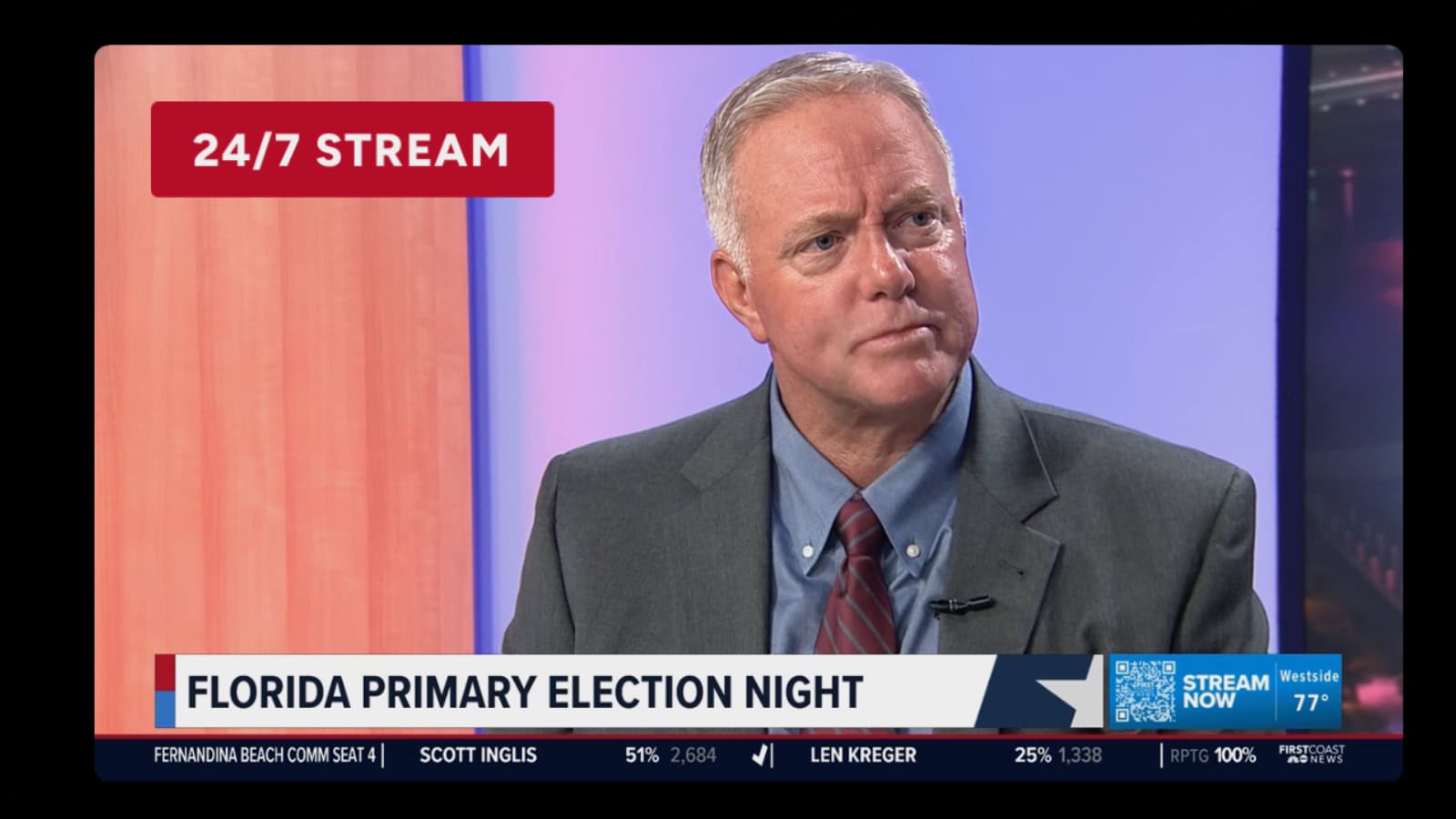
Earlier this month I was preparing a lecture on the use of disinformation in political campaigns for the course on political advertising I teach at the University of North Florida. Reviewing past lectures, it struck me that 2026 marks 10 years I’ve been teaching this course while also serving as a political analyst for First Coast News.
It’s hard to fathom, but certainly worth considering, how much has changed during the decade since that night in 2016 when we all were left contemplating – and me trying to explain on live TV – how Donald Trump beat Hillary Clinton to claim the U.S. presidency.
It also begs many questions about the reality of what we see in political campaigns today as well as what we expect in the future: 2016’s predictions meet 2026’s reality.
- Artificial intelligence will allow what feels like interactive, one-on-one conversations to occur simultaneously between a single candidate and thousands of voters.
- Fake videos will become so easy to make and so hard to detect that voters will no longer know what’s real and what’s a lie.
- Voters will consult chatbots about how to cast their ballots.
- Instead of spending days polling hundreds of real voters, campaigns will mold messaging using live real-time feedback from thousands of AI-simulated voters.
Most of the students I teach this semester have never known American politics without Trump’s overwhelming populist influence. Discussions about the kind of civility we witnessed between John McCain and Barrack Obama in 2008 seem as unreal to them today as did my predictions to 2016 students that social media would one day become the primary source where most voters get information about candidates.
Daigle Creative has managed more than 50 political campaigns in the last quarter century: for Democrat and Republican candidates. We’re very proud of our win record that stands at almost 90%. We’re also aware that what we did to help candidates win in the past doesn’t necessarily work anymore. That’s why we must continue to constantly adapt to the rapidly changing landscape.
Direct mail has become cost prohibitive and highly unreliable. Few voters under 40 even check their mail. Ads on linear broadcast TV still work for voters 55+, but communicating with millennials and Gen-Z is so much more complex because of the popularity of myriad new channels from podcasts to vlog platforms. Paid online influencers are an important part of any serious campaign strategy now. Answer Engine Optimization has replaced Search Engine Optimization.
In his groundbreaking 2024 book Reinventing Political Advertising, one of the greatest political consultants of our time, the late Hal Malchow, asked “why, when 90% of American voters are voting straight party tickets, are we still spending almost 100% of our money on candidate ads?” Malchow argued the future of effective political campaign ads will hype parties, not candidates.
Malchow’s 2024 prediction seems eerily clairvoyant today following last month’s Supreme Court ruling that struck down the limits on coordination between parties and candidates while permitting parties to now qualify for the incredibly important lowest unit rate charges on ads that were formerly reserved for candidates only.
Today, I’m telling students that we may already have witnessed the last U.S. presidential campaign between only two major parties, and the last campaign in which traditional broadcast TV was where most political ad money was spent.
So much of today’s political advertising employs technology to focus on amplifying or channeling group-based identity threats. Advertisers use generative AI programs to plan ads by identifying strategic points of behavioral decision influence: particular times or types of moods when voters are receptive to persuasion and influence.
AI disinformation, fake news, surveillance capitalism, clickbait, deepfakes, barrage jamming, spamouflage, astroturfing, false flag ads…You’ll be forgiven if you don’t recognize all these modern campaign ad strategies. How far we’ve come from the simplicity of whistle-stop campaigns. Bigtime campaigns today can seem more like covert CIA black ops.
Yet, there remain valuable lessons in the tremendous past campaign work Daigle Creative has been a part of, as well as in the evolutions we’ve seen during the last decade.
No matter how good technology gets, it can’t replace timely human ideas that sympathize and solve or somehow address people’s problems. Chatbots still can’t replicate real human compassion, or courage.
What I originally fell in love with about politics was the bigger-than-life characters: Jake Godbold, Tommy Hazouri, Tillie Fowler, Betty Holzendorf, Ed Austin, Mary Singelton and Joe Carlucci Sr. They were fascinating public figures leading fierce campaigns about their unique ideas.
Those characters still exist on campaign trails today. It’s just incumbent on us as voters to sift through all the tech and treachery to spot the humanity in those who seek to lead us into the next terrifying ten years. Good luck this week candidates, and voters!